
Hardwood vs Composite Decking: Which Should You Choose?
Choosing between hardwood and composite is one of the biggest decisions when you plan a new outdoor space. Both can make a great deck, but they give you a very different experience.
Hardwood gives you something no factory can fully copy — real natural timber. Every board has its own grain, colour shift, character. A premium hardwood like Ipé, Iroko or Balau can make a terrace feel like proper architecture. Composite takes a different route. Instead of a solid piece of timber, it uses engineered materials designed to look more consistent and need less routine maintenance.
So which is better? There isn't one answer for every garden.
If you love real timber and you are happy that its colour will change as it weathers — and that keeping its original colour means treating it now and then — hardwood can be outstanding. If you want a more predictable look and you don't want to be out there oiling it every year, a good composite will probably suit you more. It comes down to appearance, maintenance, budget, where it is and how you want it to age.
The Main Differences
Hardwood is real timber. Every board has its own grain and tone, and premium hardwoods can make a beautiful high-end finish. It naturally changes with sun and weather and will gradually silver over. If you want to keep that richer colour, you will need to clean and treat it now and then.
Composite is engineered to be more consistent and lower maintenance. It doesn't normally need sanding, staining or oiling, but it still needs cleaning. How it looks and performs varies a lot between products. Hardwood can sometimes be sanded and refinished if it gets marked or weathered. If a composite board gets badly damaged, you usually have to replace that board. Natural timber can also develop small checks or splinters as it ages, composite doesn't get timber splinters.
They also move differently. Hardwood moves mainly with moisture. A lot of conventional composites move mainly with temperature. So gaps and fixing details have to suit the actual material you are fitting. Both can give you a long-lasting premium surface if they are specified and installed properly. And remember, neither category is one product. Ipé, Iroko and Balau are all different, just like composites vary hugely in quality and construction.
What Is Hardwood Decking?
Hardwood decking is made from dense timber species picked for how they look and how suitable they are outside. The common premium ones in the UK are Ipé, Iroko and Balau, but there are others. The important thing to understand is hardwood doesn't mean one level of performance. Species vary a lot in density, strength, colour, natural durability, movement, oil content, how easy they are to work and price. That is why a quote that just says hardwood decking doesn't tell you enough. What timber is it actually?
What Is Composite Decking?
Most conventional composite is wood-plastic composite — wood fibres or flour mixed with polymers, pigments and additives. As we covered in our Millboard vs Composite guide, there is a big difference between products. Some boards are hollow, some solid, some capped, some uncapped, grooved or square-edged, and finishes range from fairly flat uniform colours to really sophisticated multi-tonal timber effects. A cheap hollow board shouldn't be compared to a premium capped board like they are the same thing.
Where Does Millboard Fit In?
Millboard sits inside the wider composite category, but its build is different to normal WPC. According to Millboard's current information, it is wood-free, using a mineral and polymer resin construction with reinforcement and a flexible Lastane surface. So you are really comparing three quite different approaches — natural hardwood, conventional WPC composite, and wood-free engineered alternatives like Millboard. They shouldn't be treated as just different versions of the same stuff.
Does Composite Really Look Like Hardwood?
If what you want is real natural timber, hardwood wins by definition. Every board is a real piece of wood with its own variation. For a lot of people that variation isn't a flaw, it is exactly why they want hardwood. A well-laid hardwood terrace has a warmth that is very hard to copy.
Modern premium composites can look very convincing, with deep grain and multi-tonal colours, but they are still manufactured boards. That consistency can actually be a plus if you want a cleaner, more contemporary look. So it is not really which looks better, it is whether you want the variation of real timber or the consistency of an engineered board.
Ipé, Iroko and Balau
Ipé is one of the best-known premium hardwoods. Really dense, strong, naturally durable, sophisticated looking. Fresh Ipé can be rich brown with a lot of natural variation board to board, which helps create that high-end finish. Its density is a strength, but it also makes it harder to install — you need proper tools, fixings and techniques. You can't treat it like softwood.
Iroko is another popular premium option. Colour from golden-brown through to deeper brown as it matures, warm natural look, long history in demanding external and marine use. Boards vary — one lighter, one darker — which some people love and some people don't.
Balau is also common in the UK. Warm timber look, generally dense and durable. Colour variation can be quite a bit, so you need to spread boards carefully when laying to get a balanced finish. And don't assume everything called Balau is identical — exact species, quality and source matter. Same principle for all hardwood — know what you are actually buying.
Does Hardwood Turn Grey? Does It Need Oiling?
Yes, if you leave hardwood exposed to sun and weather without maintaining its colour, it will generally change and many hardwoods go to an attractive silver-grey. That doesn't mean it is rotting — surface weathering and structural decay are not the same thing. Some people actually want that silver look.
If you want to keep the richer brown or golden tones, you will need to clean and treat it periodically with a suitable oil or finish. How often depends on species, exposure, orientation, foot traffic and what look you want. Composite is different — quality composites don't need routine sanding, staining or oiling to keep their intended look, but they still need cleaning. Leaves, algae, dirt, food, grease — none of that disappears just because it is composite.
Which Needs More Maintenance? Which Lasts Longer?
If you want to keep routine maintenance down, composite generally has the edge. Hardwood needs regular cleaning and possibly periodic oiling, and as it ages it may develop surface checking or occasional splinters depending on species and exposure. Composite avoids a lot of that, and maintenance is more about keeping it clean and keeping drainage clear.
On longevity, there isn't one winner. Premium hardwood correctly specified can last an exceptionally long time. Quality composite can also give decades of service and many premium products have substantial warranties. For timber, species and natural durability matter a lot. But just as important is what is underneath. A premium hardwood board on a poor subframe can still cause problems. The board's lifespan is not automatically the whole deck's lifespan. Subframe design, ventilation, drainage, support spacing, fixings and quality of install all matter.
Movement, Water, Heat and Slip
Hardwood absorbs and releases moisture with the environment, which contributes to movement. It doesn't mean it is unsuitable — appropriate hardwoods have been used outside for generations — but board spacing, ventilation, drainage and fixings have to allow for it. Premium capped WPC can be very resistant to moisture, while wood-free alternatives like Millboard are a different construction again. Whatever you choose, drainage underneath still matters.
Both hardwood and composite move, just not for the same reason. Hardwood moves mainly with moisture, movement across the grain is much more than along length. Many WPCs move with thermal expansion. Manufacturers specify different clearances depending on product, length and install temperature. There is no universal gap for every material.
Both can get hot in direct sun. It would be misleading to say hardwood is always cooler. Colour makes a big difference. A pale weathered hardwood and a dark charcoal composite are very different. Garden orientation, sun hours, glazing, airflow and shade matter too. If heat is important, put actual samples outside in sun and compare.
Slip resistance also depends on specific surface, condition and product, not just hardwood vs composite. A clean well-specified hardwood can give good grip, same surface covered in algae can be slippery. Many quality composite manufacturers publish slip test data. Natural timber performance varies with profile, grain, moisture, wear and contamination. Keeping it clean matters more than whether it has grooves.
Splinters, Scratches, Fixings
Natural timber can develop surface checks or splinters as it weathers — likelihood depends on species, quality, exposure and maintenance. Premium hardwood is very different to cheap softwood, but it is still natural timber. Conventional composite doesn't get natural timber splinters, which can be a plus around pools and barefoot areas. But a splinter-free surface can still be uncomfortable if it gets very hot.
Both can be scratched. With hardwood you can sometimes sand and refinish depending on depth of damage, and a small mark often becomes less noticeable as timber weathers. With composite you generally can't sand the surface without changing texture or colour, so a badly damaged board may need replacing. Either way, lift furniture, don't drag it.
Dense hardwood is more demanding to fix. Depending on species you may need pre-drilling, countersinking, stainless screws, specialist hidden fixings and proper cutting equipment. Corrosion-resistant fixings are important, especially near coast. Some species can react with unsuitable metals and cause staining. Many composites use hidden clips in side grooves. Millboard uses its own systems like Durafix face fixing and DuoFix side fixing. Fixing system should be part of design from start.
Pools, Raised Decks, Rooftops and Fire
Both can work around pools and hot tubs if specified properly, thinking about barefoot comfort, slip, drainage, surface temperature, chemicals and maintenance. Around hot tubs, weight is the big one — filled hot tub plus people is a serious concentrated load that may need extra foundations, dedicated beams or separate framing. That applies whatever the surface board is.
Both can be used on raised decks, but the bigger issue is often the subframe. For big raised, curved, multi-level and bespoke structures we often prefer welded galvanised steel primary frames. At Decking Gurus our steel frames are measured, cut, fabricated, welded and assembled on site, so we can build around actual shape and levels. Where appropriate, galvanised steel primary can then be combined with recycled-plastic secondary subframe for fixing.
Roof terraces are not just garden decks higher up. You have to consider structural loading, waterproofing, drainage, pedestal systems, build-up height, thresholds, wind, balustrades and fire performance. Weight matters, and low-profile aluminium subframes and pedestal systems can be useful to deal with falls while keeping deck level. Fire performance deserves particular attention on balconies and rooftops — hardwood or composite label alone doesn't tell you if it is suitable. You may need A1 or A2 fire-rated systems depending on building and requirements. At Decking Gurus we also install specialist A1/A2 fire-rated systems where projects require them.
Sourcing, Cost and When We Would Choose What
Responsible sourcing matters, especially with tropical hardwood. Ask about species, origin, traceability and certification like FSC where applicable. But check it relates to actual timber being supplied — just because a species can be available with certification doesn't mean every board is.
There isn't one honest answer on which is more environmentally friendly for every product. It is not simply wood = good, plastic = bad. You need to look at recycled content, raw material, manufacturing, lifespan, recyclability, transport and replacement frequency at product level.
Cost varies hugely in both categories. Composite goes from cheap hollow boards to premium capped and wood-free like Millboard. Hardwood varies with species, grade, size, availability and origin, and premium species like Ipé can be expensive. And board price is only part of job — groundwork, foundations, subframe, fixings, labour, borders, fascia, steps, balustrades, lighting, drainage, waste and access all add up.
The cheapest to install isn't always cheapest to own. If you want hardwood to stay rich brown, you have future maintenance. If you are happy to let premium hardwood silver naturally, you may not be treating it repeatedly.
We would choose hardwood when genuine natural timber, unique grain and architectural character matter most. We would choose composite when lower routine maintenance, greater consistency and practicality are higher priorities. We would look at Millboard when you like timber character but prefer wood-free engineered product with lower maintenance. As Approved Millboard Installers we work with it regularly, but we don't push it for every job. Sometimes hardwood is right, sometimes conventional composite is, sometimes Millboard is. Spec should follow project.
So choose hardwood if you value real natural material and how it changes with age. Choose composite if you value lower maintenance and consistency. Consider Millboard if you like timber look but prefer wood-free engineered. And don't decide on surface alone — consider subframe, drainage, spacing, sun, levels, balustrades, lighting, loading, maintenance and intended lifespan. A great deck is not just expensive boards, it is a complete construction.

Premium Millboard decking creates a beautiful, realistic timber look with excellent durability and low-maintenance performance.
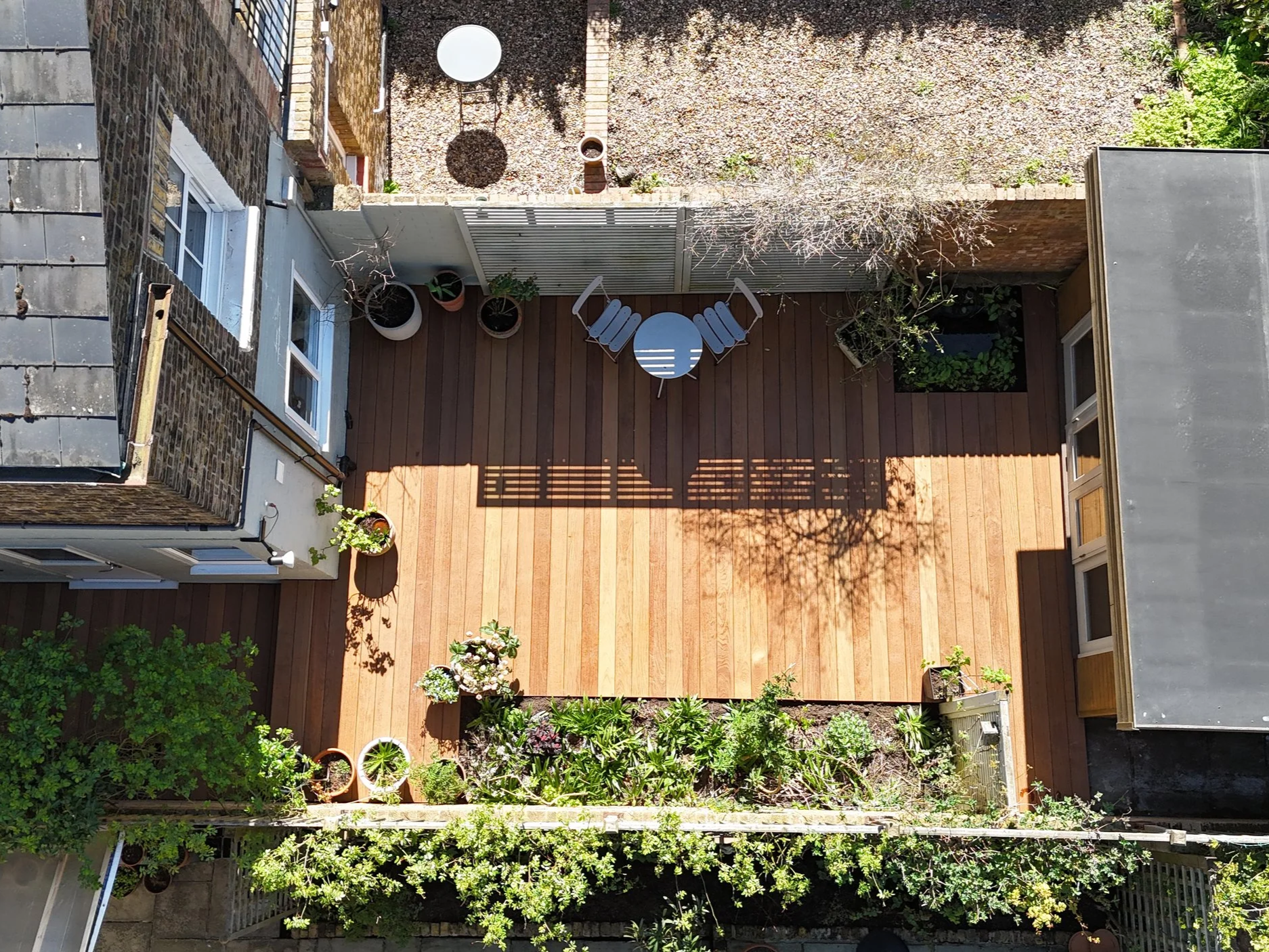
Premium hardwood decking offers natural warmth, rich grain and timeless character, creating an elegant and durable outdoor space.
